(This post was started about a week ago.) I don't remember whether I've done a post about my gardening attempts across the street this season. I have been very behind in gardening, so was glad when I was able to get some of it cleaned up recently. I think another few hours, and it will be in better shape. One of the main obstacles to gardening here is the number of trees that block light much of the day. This one is a black walnut tree, and there are not many plants that can grow near them because of a chemical in the roots.

Marigolds seem to do OK in this area. They didn't get as much water as they'd like, though, so have struggled a bit.

I planted the Mexican sunflowers late, and they are blooming much shorter than usual.

The fennel has reseeded right under the walnut tree, but the seedlings are not in the photo. The irises are doing OK.

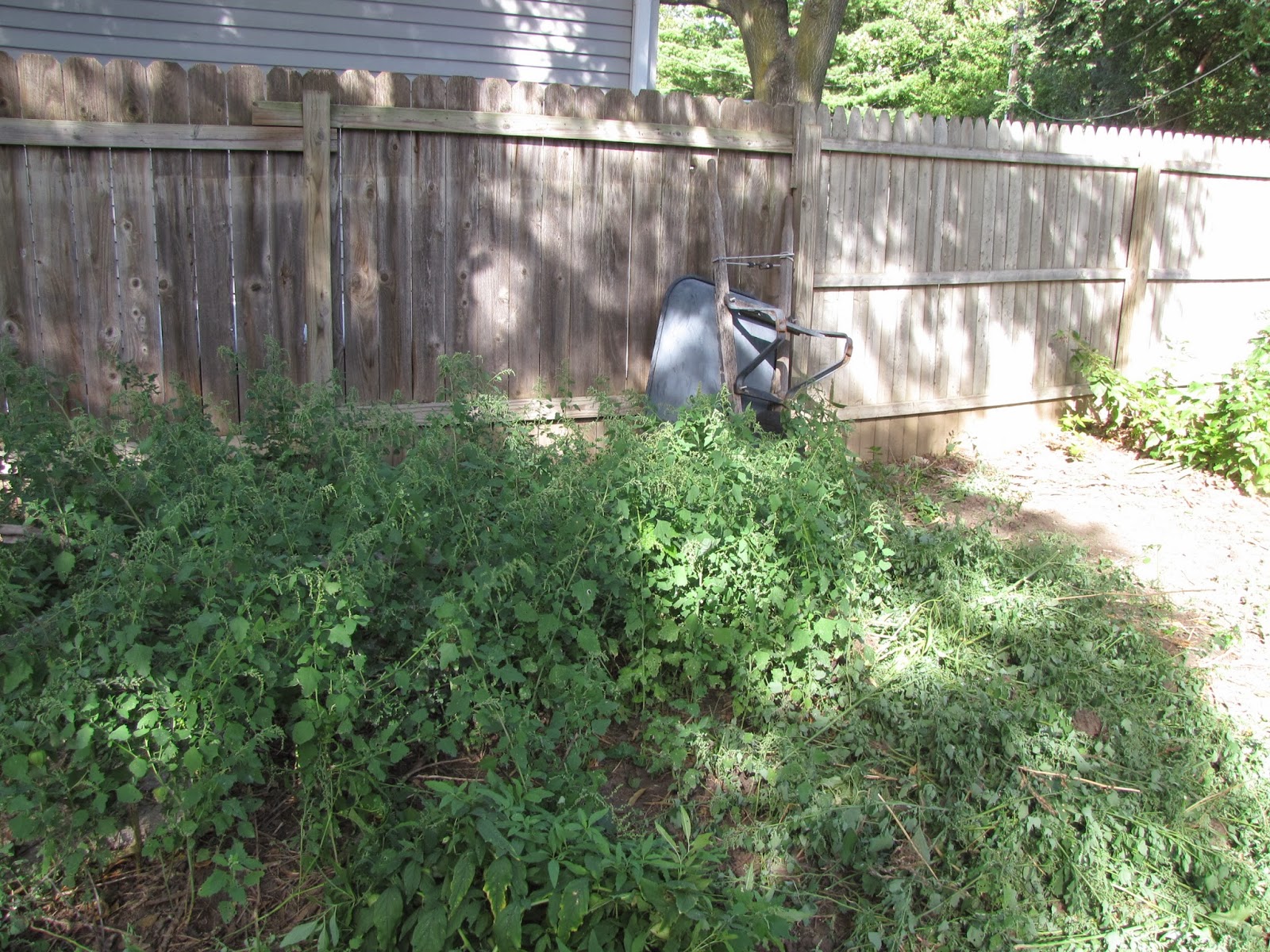
I have trouble getting things to grow in the shade next to the fence. I had a few Money plants, and now have lots! They are biennial, so next year, there will be a sea of purple blooms here, followed by lots of "coin" seedheads. Wow! We'll be rich! I think I should thin them a bit. Anyone in town want some transplants next spring? That's a Sweet pea vine on the dealy that used to have a mirror on it.

It's nice to find plants that will do well under the trees.

I don't remember whether this is Solomon's seal or False solomon's seal. A friend gave me this start a few years ago, and it is not spreading so far, but comes back. I'm not sure what the dark green vine is. Do you know what it is?

The same friend who gave me the Solomon's seal also got me started growing an heirloom self seeding annual, Kiss me over the garden gate. It gets from 4 to 6 feet tall. I didn't get these watered much this summer, so they have struggled. They are growing right under the walnut tree, where they did very well the previous couple of seasons.

I have been meaning to get more compost and other soil in this area, in hopes of keeping the rabbits out, but have read somewhere that they will probably be able to get up there. The carrots are doing pretty well, but the lettuce I planted a few weeks ago, did not get enough water to grow.

I don't remember how many Ground cherry plants there have been in the past, maybe because I didn't know what they were. I've learned there are different kinds. These look like the Virginia groundcherries in my Weeds of the Great Plains book, published by the Nebraska Department of Agriculture. I will refer to some of the information I looked up in it about some of the other plants in this post, as well. Oh, and there are at least four kinds of Virginia groundcherry in our region.

The berries are poisonous when green, but not when ripe. I have tasted a few, but they were probably not as ripe as they should have been. The husks turn light brown when they are ripe. I've noticed that the flowers came on at different times, so they will ripen at different times as well. Birds and small mammals eat the berries.

I wasn't sure if the zinnias would bloom, since I didn't get the seeds planted until June. I planted 6 hills/clumps of summer squash, but only one looks like it may produce. Insects have made short work of the others.

I'm glad the zinnias did bloom, because I've seen butterflies on them.

The tomatoes and peppers have struggled, but have produced some.


Looking to the north, there is a place where I have placed some branches and other things I don't want on the compost pile. There is a mulberry tree coming up. I am thinking about letting it grow to see how it will do right next to another tree.

This Nasturtium is back in the main part of the garden.

Looking back to the north, and eastish, I pulled up lots of Lambsquarters last week, defining the area where I plan to let them grow next year. We ate lots of them this summer, raw, and cooked, but there were too many, and some were blocking the path. The plant is one that came from Europe, so it's not native. Songbirds eat the seeds, so we aren't the only ones who eat it.

There are several clumps of Anise hyssop in the yard. There is also some catnip, and I have taken to smelling the leaves to see which is which if I'm not sure.

I decided to pull the Horseweed, after letting a few plants grow most of the summer, since they are native to our area. It is on the pile next to the compost, where I put things with seeds that I don't want to risk putting in the compost. I learned that this is one of the few weeds that has spread to Europe. I don't know if I ever knew what variety of red raspberries these are, because I got them from a friend's plant sale that she has in her yard.

They produced pretty well this summer, but I didn't harvest regularly, so the birds probably got a few more than we did, but maybe we will get more next year. They are doing well enough that I want to plant some more next year. If something will grow over here, I need to take advantage of that.

I planted a couple varieties of Viburnums and a Mock orange in hopes of blocking the view of the neighbors. There are also some weeds I'm letting grow.

This is Mapleleaf goosefoot, a native plant. Someone told me the birds like to eat the seeds, but the book I'm referring to doesn't mention it. It says Native Americans ground the seeds into flour, and made green dye with the leaves.

I have Pokeweed, another native, coming up all over the place, but only let one or two grow each season so the birds can have the berries to eat. Some people eat the greens when they first emerge in the spring, but they become poisonous at some point, so I haven't tried doing that so far. Some people make dye with the berries.

This is one thornless blackberry plant yhat is spreading around. I'm not sure if one is supposed to pin down the stems where you want them to root, or if they will do it on their own. They haven't yet. The day after I took these photos, I dug buckets of compost, and some were put in this area and around the raspberries previously shown.

Heading back west, there are perennial Geraniums I had moved from the curb areas back home when they put new curbs in. A number of years ago, I gave the renter at that time some Bellflowers, and she put them in this area. They are trying to take over. I have hoed them a couple times this summer, and need to again. I have a theory/hope that if I keep after them, they will at some point, give up.

This looks like some kind of Aster growing in with the Bellflowers. I'll be careful of it next time I hoe the Bellflowers.

I see one of the Bellflowers is blooming. They are a pretty flower. I wish they didn't spread so far and wide.

I was tickled that this fence kept the rabbits out, and I was able to harvest some some green beans, but then all of a sudden, some kind of insects ate up the leaves.

Continuing to walk toward the west, facing northwest, this is a very healthy Anise hyssop plant that seems to like where it's planted.

I forgot to show the beets coming up. I suppose they won't have time to develop before the cold weather, but maybe we'll get some greens.

There is an area, about 3 by 4 feet on the north side of the garage, where some wild four o'clocks vie for spots to grow with whatever other weeds are there.

I included this photo looking east to show the path I widened by pulling out a lot of the Lamb'squarters.

I am not know how to identify many kinds of trees. Do you know what
these are? They have not been well maintained. I wish they never would
have been allowed to grow here. I don't think they were planted by
people.


Here's another weed that I don't know.

The previous renter made this pile of parts of trees. That's her old strawberry bag, too. I keep forgetting to dump the dirt out and see if it can be recycled. I planted this Goldenrod a number of years ago.

I should have planted the Aster on the other side of it. Oh, maybe it's a volunteer. I don't remember. I was pleased to see the praying mantis on it.

I went back over to find more weeds to take photos of. I wonder what kind of thistle this is. It is close to the street side of the garden, so I'll probably dig it out.

I didn't find this one in the weed book yet. Do you know what it is?

I am pleased that I got some compost put around and planted garlic. It is later than I usually get it planted. The ones I planted at home a week or so ago are coming up, so, hopefully, these will be fine. I hope to plant another row of raspberries next to the row of garlic.

I seem to be keeping the bindweed and honeyvine milkweed pulled enough so that they are not taking over.

I pull most of the Spanish needles when I come across them. I just read that they are native, and the seeds are eaten by quail, pheasants, songbirds and small mammals. My problem with them, is that they stick into my clothes if I'm not careful, and their poke hurts. Have any of you eaten them? I just learned that some Native Americans and early pioneers boiled and ate the young leaves as greens.

Here's a closer view of the seeds.

What kinds of weeds do you either let grow for the critters or eat yourselves?

Marigolds seem to do OK in this area. They didn't get as much water as they'd like, though, so have struggled a bit.

I planted the Mexican sunflowers late, and they are blooming much shorter than usual.

The fennel has reseeded right under the walnut tree, but the seedlings are not in the photo. The irises are doing OK.

I have trouble getting things to grow in the shade next to the fence. I had a few Money plants, and now have lots! They are biennial, so next year, there will be a sea of purple blooms here, followed by lots of "coin" seedheads. Wow! We'll be rich! I think I should thin them a bit. Anyone in town want some transplants next spring? That's a Sweet pea vine on the dealy that used to have a mirror on it.

It's nice to find plants that will do well under the trees.

I don't remember whether this is Solomon's seal or False solomon's seal. A friend gave me this start a few years ago, and it is not spreading so far, but comes back. I'm not sure what the dark green vine is. Do you know what it is?

The same friend who gave me the Solomon's seal also got me started growing an heirloom self seeding annual, Kiss me over the garden gate. It gets from 4 to 6 feet tall. I didn't get these watered much this summer, so they have struggled. They are growing right under the walnut tree, where they did very well the previous couple of seasons.

I have been meaning to get more compost and other soil in this area, in hopes of keeping the rabbits out, but have read somewhere that they will probably be able to get up there. The carrots are doing pretty well, but the lettuce I planted a few weeks ago, did not get enough water to grow.

I don't remember how many Ground cherry plants there have been in the past, maybe because I didn't know what they were. I've learned there are different kinds. These look like the Virginia groundcherries in my Weeds of the Great Plains book, published by the Nebraska Department of Agriculture. I will refer to some of the information I looked up in it about some of the other plants in this post, as well. Oh, and there are at least four kinds of Virginia groundcherry in our region.

The berries are poisonous when green, but not when ripe. I have tasted a few, but they were probably not as ripe as they should have been. The husks turn light brown when they are ripe. I've noticed that the flowers came on at different times, so they will ripen at different times as well. Birds and small mammals eat the berries.

I wasn't sure if the zinnias would bloom, since I didn't get the seeds planted until June. I planted 6 hills/clumps of summer squash, but only one looks like it may produce. Insects have made short work of the others.

I'm glad the zinnias did bloom, because I've seen butterflies on them.

The tomatoes and peppers have struggled, but have produced some.


Looking to the north, there is a place where I have placed some branches and other things I don't want on the compost pile. There is a mulberry tree coming up. I am thinking about letting it grow to see how it will do right next to another tree.

This Nasturtium is back in the main part of the garden.

Looking back to the north, and eastish, I pulled up lots of Lambsquarters last week, defining the area where I plan to let them grow next year. We ate lots of them this summer, raw, and cooked, but there were too many, and some were blocking the path. The plant is one that came from Europe, so it's not native. Songbirds eat the seeds, so we aren't the only ones who eat it.
There are several clumps of Anise hyssop in the yard. There is also some catnip, and I have taken to smelling the leaves to see which is which if I'm not sure.

I decided to pull the Horseweed, after letting a few plants grow most of the summer, since they are native to our area. It is on the pile next to the compost, where I put things with seeds that I don't want to risk putting in the compost. I learned that this is one of the few weeds that has spread to Europe. I don't know if I ever knew what variety of red raspberries these are, because I got them from a friend's plant sale that she has in her yard.

They produced pretty well this summer, but I didn't harvest regularly, so the birds probably got a few more than we did, but maybe we will get more next year. They are doing well enough that I want to plant some more next year. If something will grow over here, I need to take advantage of that.

I planted a couple varieties of Viburnums and a Mock orange in hopes of blocking the view of the neighbors. There are also some weeds I'm letting grow.

This is Mapleleaf goosefoot, a native plant. Someone told me the birds like to eat the seeds, but the book I'm referring to doesn't mention it. It says Native Americans ground the seeds into flour, and made green dye with the leaves.

I have Pokeweed, another native, coming up all over the place, but only let one or two grow each season so the birds can have the berries to eat. Some people eat the greens when they first emerge in the spring, but they become poisonous at some point, so I haven't tried doing that so far. Some people make dye with the berries.

This is one thornless blackberry plant yhat is spreading around. I'm not sure if one is supposed to pin down the stems where you want them to root, or if they will do it on their own. They haven't yet. The day after I took these photos, I dug buckets of compost, and some were put in this area and around the raspberries previously shown.

Heading back west, there are perennial Geraniums I had moved from the curb areas back home when they put new curbs in. A number of years ago, I gave the renter at that time some Bellflowers, and she put them in this area. They are trying to take over. I have hoed them a couple times this summer, and need to again. I have a theory/hope that if I keep after them, they will at some point, give up.

This looks like some kind of Aster growing in with the Bellflowers. I'll be careful of it next time I hoe the Bellflowers.

I see one of the Bellflowers is blooming. They are a pretty flower. I wish they didn't spread so far and wide.

I was tickled that this fence kept the rabbits out, and I was able to harvest some some green beans, but then all of a sudden, some kind of insects ate up the leaves.

Continuing to walk toward the west, facing northwest, this is a very healthy Anise hyssop plant that seems to like where it's planted.

I forgot to show the beets coming up. I suppose they won't have time to develop before the cold weather, but maybe we'll get some greens.

There is an area, about 3 by 4 feet on the north side of the garage, where some wild four o'clocks vie for spots to grow with whatever other weeds are there.

I included this photo looking east to show the path I widened by pulling out a lot of the Lamb'squarters.


Here's another weed that I don't know.

The previous renter made this pile of parts of trees. That's her old strawberry bag, too. I keep forgetting to dump the dirt out and see if it can be recycled. I planted this Goldenrod a number of years ago.

I should have planted the Aster on the other side of it. Oh, maybe it's a volunteer. I don't remember. I was pleased to see the praying mantis on it.

I went back over to find more weeds to take photos of. I wonder what kind of thistle this is. It is close to the street side of the garden, so I'll probably dig it out.

I didn't find this one in the weed book yet. Do you know what it is?

I am pleased that I got some compost put around and planted garlic. It is later than I usually get it planted. The ones I planted at home a week or so ago are coming up, so, hopefully, these will be fine. I hope to plant another row of raspberries next to the row of garlic.

I seem to be keeping the bindweed and honeyvine milkweed pulled enough so that they are not taking over.

I pull most of the Spanish needles when I come across them. I just read that they are native, and the seeds are eaten by quail, pheasants, songbirds and small mammals. My problem with them, is that they stick into my clothes if I'm not careful, and their poke hurts. Have any of you eaten them? I just learned that some Native Americans and early pioneers boiled and ate the young leaves as greens.

Here's a closer view of the seeds.

What kinds of weeds do you either let grow for the critters or eat yourselves?


