There has been some growth since I last posted on the area where the tree used to be. When I posted, I said I was going to show the area on the south side of the fence in another post, but I forgot to. I will do both in this post.
I always like to include a photo of the view from our front door. The bed on the left has been there a few years. The area to the right is where the tree used to be, and most of these plants were planted last year, with some additions this year.

This is the area I've tried to mostly plant native plants in. Some of the plants I thought were native when I bought them aren't, but so far, I am keeping them there to see how I like them. In a month or so, a number of the plants will be much taller than what they are now, and much less dirt will be showing.

Some of the plants in this area are, alliums that I moved from the side yard, switchgrass, 'northwind', wild quinine, and clematis, hexapetala, 'Mongolian Snowflakes', which I thought was native, but is not.

Farther west, are giant fleeceflower, a couple varieties of liatris, prairie clover and mallow covered to protect them from rabbits, and the two large clumps are grey headed coneflowers.

Larry and I put mulch on the path and in the sitting area. We are trying to decide whether to put some in the planting areas. I think I'll skip it, because I am gardening on the cheap this year in order to get the home equity loan we took out when we had our kitchen remodeled paid off.

I am looking forward to seeing how tall the culver's root and other plants will get this summer.

I love the golden alexander plants and flowers, which should be growing to be 2 and a half feet tall.

This is a different kind of allium that I moved from the side yard. Do you know what they are?

I moved the baptisia on the left from the side yard last spring. It must have been an OK size to move, because they are not supposed to like to be moved. There are a variety of liatris and rudbeckias here. The clump on the right that is cut off, is rigid goldenrod, I'm pretty sure.

Here is a close-up of the helenium hoopesii, which I had never heard of until last year. It's a perennial, but I hope it also reseeds.

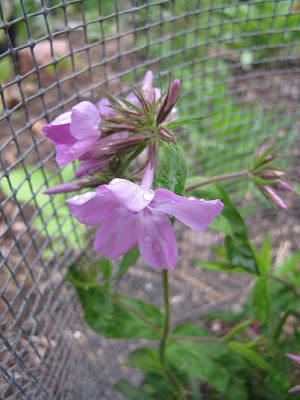
This is phlox pilosa,' Eco Happy Traveler'. I took the cage off this evening to put it on something else the rabbits have been eating. I hope this is large enough they won't be interested in it anymore.
The fluffy looking plants are larkspur, an annual that reseeds. That's a closer view of a grey headed coneflower on the right. I am seeing phlox, clematis, and little bluestem grass close by.

The agastache plants survived our mild winter. I hope the hummingbirds come back and enjoy them like at least two of them did last year. It was awesome seeing one multiple times a day for a few weeks. The rudbecia maxima could get 5 to 7 feet tall, and 3 feet wide. There are also coneflowers, geum 'Prairie Smoke', wild columbine, aster, and a purple milkweed in this area.

I took the next couple of photos a different day from the others because I hadn't shown the pot of gooseneck loosestrife on the bench trellis, or the straight on view of the bench with the strawberries growing underneath.

Earlier this spring, I pruned back the honeysuckle vine that a neighbor lady gave me when we first moved in, but it looks like it could use another trimming back.

On the other side of the bench trellis, are the senna I got from Ben, who blogs at The Deep Middle, a switchgrass, yarrow, 'Paprika', and on the right, helenium autumnale. The lamb's ears and coreopsis were already planted before the tree came down.

This is the west edge of the area. The grass is in our neighbors' yard. Under the basket is a leadplant. The beautyberry bush was already planted a few years ago. I moved some joe pye weed from the east front bed next to it. I have volunteers coming up in the tubs, but have also moved some marigolds that self sowed in our garden last year to some of the tubs.

Here's the view back to the east. The plant in the right lower corner is one of the two black and blue salvias that also survived winter, and were enjoyed by the hummingbirds last summer.

I zoomed in to see the amsonia, maybe tabernaemontana and the phlox. I'm trying to remember whether I purchased the amsonia, or moved it from another part of the yard.

I see Culver's root, inulas, switchgrass, 'Heavy Metal', pasque flowers, little bluestem, and euphorbia.

I planted several nodding ladies' tresses this year. I hope they do well.

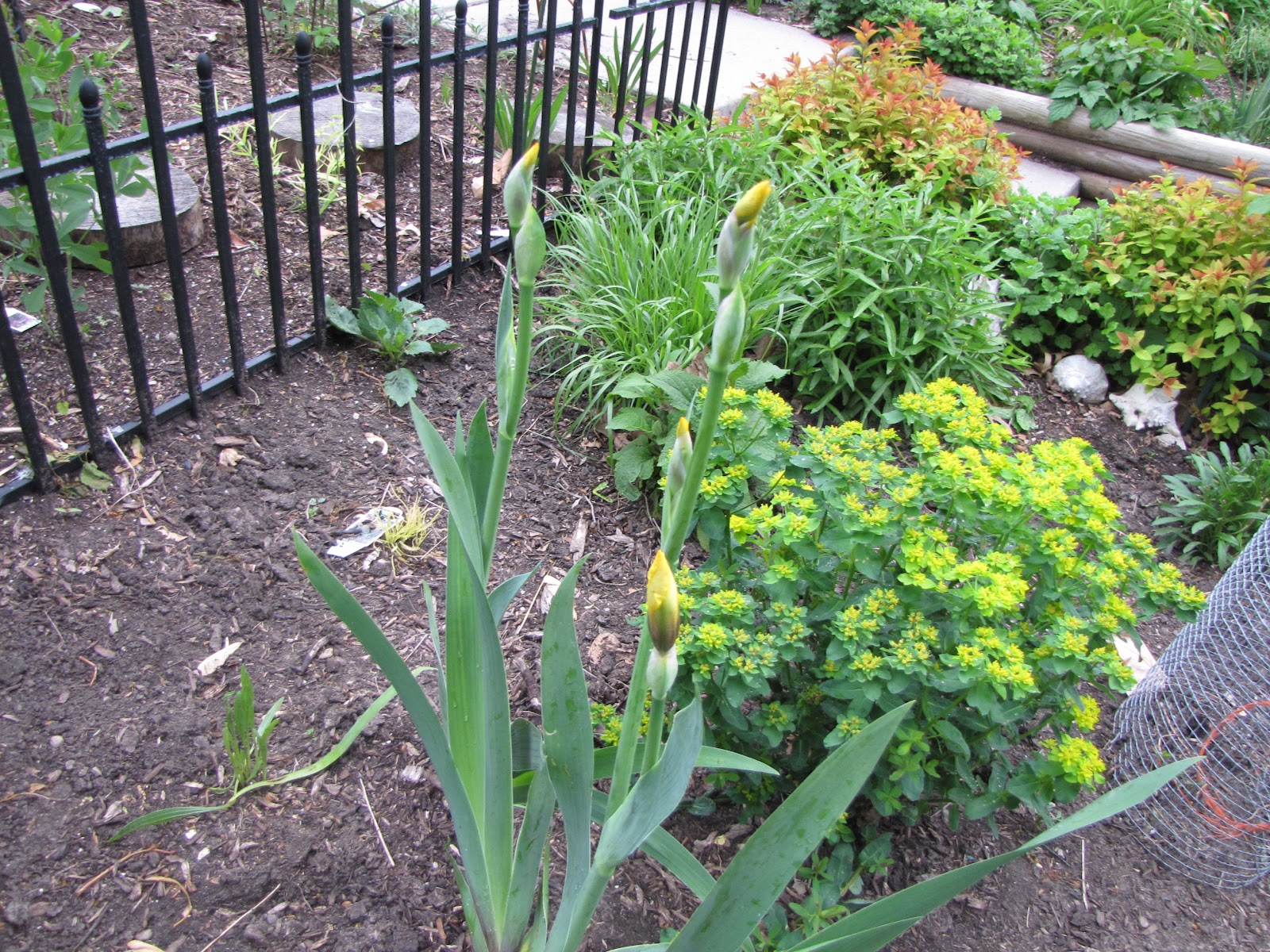
Here's a closer view of the euphrobia, growing around a pasque flower, little bluestem, liatris, narrow leaf coneflowers, phlox, and some plants I can't remember the names of. I haven't decided if I'm going to keep the irises in this area.

The little silver plants are pussytoes, which I'm looking forward to seeing spread around. The phlox are doing well for this being their second season here.

I have mentioned that I am not a landscaper, and am not good at making plans. I tend to get a bunch of plants, set them around until I like how they look, and then plant them. One thing I kind of did here, was to put some plants in diagonal rows with lots of space for other plants between them. The grey headed coneflower behind the red hot poker plant is kind of in a row with the other two on the other side of the fence. I am looking forward to seeing if I like that when they bloom. I also see prairie clover, sedum, 'Black Jack', amorpha nana, and more liatris, which is weaving its way through this whole area.

I love this little mullein. I hope the tag turns up.

I don't remember if this is from last year or this. Do you know what it is?

I don't remember what the big leaved plant on the left is. The scraggly plants near the sun stake are agastaches. Hopefully, they will grow and fill in the spaces here like they did last year.

I was in a bit of a hurry to get this area planted last year, because the guy who tilled said we needed to put in a retaining wall, or all of the dirt was going to wash out of the yard. I did some looking into it, and found that if we got it planted right away, it should be OK. Some of the plants, like iris, may end up not staying. I already moved the daylilies out of the area. Still, the iris looks like it will be color coordinated with the euphorbia. The little plant on the left is a dahlia that didn't get dug up, yet survived due to our mild winter.

The liver leaf plants that were in between the phlox have all gone dormant except this one.

I had lots of annuals in these beds last year, but am trying to fill in the spaces with more perennials this year. I moved a goldenrod next to the spireas Larry requested a number of years ago, and were already growing next to what used to be grass. I am also seeing foxglove, asters, pasque flowers, and a thin leaved coneflower of some kind.

I am going to need to trim the spireas, because they are growing over the chyrsanthemums that I may decide to take out.

We are finished with the tour, and I have spent too much time on it. I know folks are always patient and forgiving when I have typos or other mistakes in my posts, plus, I am having trouble staying awake, to I am going to publish this and hope for the best.

Happy Spring!
I always like to include a photo of the view from our front door. The bed on the left has been there a few years. The area to the right is where the tree used to be, and most of these plants were planted last year, with some additions this year.

This is the area I've tried to mostly plant native plants in. Some of the plants I thought were native when I bought them aren't, but so far, I am keeping them there to see how I like them. In a month or so, a number of the plants will be much taller than what they are now, and much less dirt will be showing.

Some of the plants in this area are, alliums that I moved from the side yard, switchgrass, 'northwind', wild quinine, and clematis, hexapetala, 'Mongolian Snowflakes', which I thought was native, but is not.

Farther west, are giant fleeceflower, a couple varieties of liatris, prairie clover and mallow covered to protect them from rabbits, and the two large clumps are grey headed coneflowers.

Larry and I put mulch on the path and in the sitting area. We are trying to decide whether to put some in the planting areas. I think I'll skip it, because I am gardening on the cheap this year in order to get the home equity loan we took out when we had our kitchen remodeled paid off.

I am looking forward to seeing how tall the culver's root and other plants will get this summer.

I love the golden alexander plants and flowers, which should be growing to be 2 and a half feet tall.

This is a different kind of allium that I moved from the side yard. Do you know what they are?

I moved the baptisia on the left from the side yard last spring. It must have been an OK size to move, because they are not supposed to like to be moved. There are a variety of liatris and rudbeckias here. The clump on the right that is cut off, is rigid goldenrod, I'm pretty sure.

Here is a close-up of the helenium hoopesii, which I had never heard of until last year. It's a perennial, but I hope it also reseeds.


The fluffy looking plants are larkspur, an annual that reseeds. That's a closer view of a grey headed coneflower on the right. I am seeing phlox, clematis, and little bluestem grass close by.

The agastache plants survived our mild winter. I hope the hummingbirds come back and enjoy them like at least two of them did last year. It was awesome seeing one multiple times a day for a few weeks. The rudbecia maxima could get 5 to 7 feet tall, and 3 feet wide. There are also coneflowers, geum 'Prairie Smoke', wild columbine, aster, and a purple milkweed in this area.

I took the next couple of photos a different day from the others because I hadn't shown the pot of gooseneck loosestrife on the bench trellis, or the straight on view of the bench with the strawberries growing underneath.

Earlier this spring, I pruned back the honeysuckle vine that a neighbor lady gave me when we first moved in, but it looks like it could use another trimming back.

On the other side of the bench trellis, are the senna I got from Ben, who blogs at The Deep Middle, a switchgrass, yarrow, 'Paprika', and on the right, helenium autumnale. The lamb's ears and coreopsis were already planted before the tree came down.

This is the west edge of the area. The grass is in our neighbors' yard. Under the basket is a leadplant. The beautyberry bush was already planted a few years ago. I moved some joe pye weed from the east front bed next to it. I have volunteers coming up in the tubs, but have also moved some marigolds that self sowed in our garden last year to some of the tubs.

Here's the view back to the east. The plant in the right lower corner is one of the two black and blue salvias that also survived winter, and were enjoyed by the hummingbirds last summer.

I zoomed in to see the amsonia, maybe tabernaemontana and the phlox. I'm trying to remember whether I purchased the amsonia, or moved it from another part of the yard.

I see Culver's root, inulas, switchgrass, 'Heavy Metal', pasque flowers, little bluestem, and euphorbia.

I planted several nodding ladies' tresses this year. I hope they do well.

Here's a closer view of the euphrobia, growing around a pasque flower, little bluestem, liatris, narrow leaf coneflowers, phlox, and some plants I can't remember the names of. I haven't decided if I'm going to keep the irises in this area.

The little silver plants are pussytoes, which I'm looking forward to seeing spread around. The phlox are doing well for this being their second season here.

I have mentioned that I am not a landscaper, and am not good at making plans. I tend to get a bunch of plants, set them around until I like how they look, and then plant them. One thing I kind of did here, was to put some plants in diagonal rows with lots of space for other plants between them. The grey headed coneflower behind the red hot poker plant is kind of in a row with the other two on the other side of the fence. I am looking forward to seeing if I like that when they bloom. I also see prairie clover, sedum, 'Black Jack', amorpha nana, and more liatris, which is weaving its way through this whole area.

I love this little mullein. I hope the tag turns up.

I don't remember if this is from last year or this. Do you know what it is?

I don't remember what the big leaved plant on the left is. The scraggly plants near the sun stake are agastaches. Hopefully, they will grow and fill in the spaces here like they did last year.

I was in a bit of a hurry to get this area planted last year, because the guy who tilled said we needed to put in a retaining wall, or all of the dirt was going to wash out of the yard. I did some looking into it, and found that if we got it planted right away, it should be OK. Some of the plants, like iris, may end up not staying. I already moved the daylilies out of the area. Still, the iris looks like it will be color coordinated with the euphorbia. The little plant on the left is a dahlia that didn't get dug up, yet survived due to our mild winter.
The liver leaf plants that were in between the phlox have all gone dormant except this one.

I had lots of annuals in these beds last year, but am trying to fill in the spaces with more perennials this year. I moved a goldenrod next to the spireas Larry requested a number of years ago, and were already growing next to what used to be grass. I am also seeing foxglove, asters, pasque flowers, and a thin leaved coneflower of some kind.

I am going to need to trim the spireas, because they are growing over the chyrsanthemums that I may decide to take out.

We are finished with the tour, and I have spent too much time on it. I know folks are always patient and forgiving when I have typos or other mistakes in my posts, plus, I am having trouble staying awake, to I am going to publish this and hope for the best.


