Monday, June 22, 2015

View from the Front Porch

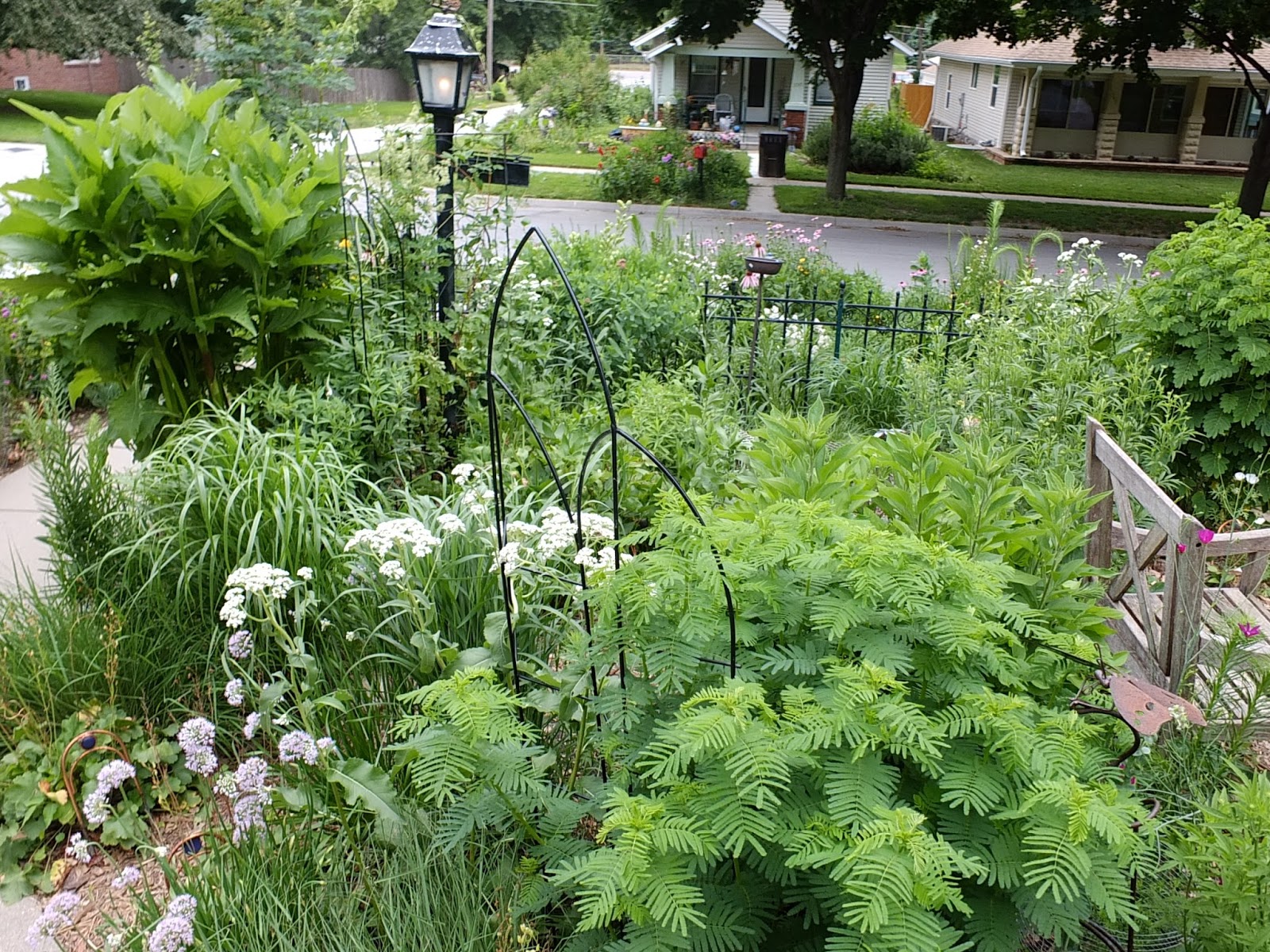
Every once in awhile, I like to stand on the porch and take some photos.  It's fun to see the changes over the season.


I trimmed back the joe pye weed last week because the ends were drooping in the heat of the afternoons, and so it will take up as much room over the sidewalk.  I've had to tie up a number of plants due to how tall and floppy they are getting due to all of the rain we've had.  The meadow rue plants were falling down before I tied a string around them.


The wild quinine blooms are outlasting the golden alexanders.  Soon, the mountain mint and liatris will be blooming.


I dug out quite a few purple coneflowers this year.  Some of them have been getting aster yellows, so I didn't want as many as there were last year.  The pale purple coneflowers are looking good, but rabbits have eaten some of them down, and reduced the amount of blooms.  Purple prairie clover is one of my favorites, and one of the favorites of rabbits, so I have them caged.


I cut some of the stems off of the cup plant so it can't droop over the sidewalk.  Rabbits ate some of the Illinois bundleflower foliage.  I'm glad they didn't get it all.


When I planted this mallow, I didn't realize it was a taller kind.  The white blooms on the other side of the chair are another mallow cultivar.


Gray-headed coneflowers are about to bloom.  The wild senna foliage is looking awesome, and the rudbeckia maxima is blooming shorter than usual.


I had to tie up the fleabane the other day, because it was falling over.  I also have been tying up the lanceleaf coreopsis plants.  The blooms under the bench are the native purple poppy mallows.


The clematis pitcheri on the trelllis has needed to be cut back since it has run out of support.  For some reason, the younger one is blooming before this one.  That's yarrow near the grass, a switchgrass cultivar I'm not remembering the name of.


I think these are outhouse flowers.  They are going to have to come out this fall, though, because we are getting water into our basement from this raised flower box that was there, I think, when the house was built.  I am not sure what his plan is, but I think it involves cement.


Even though we've had way more rain than normal this season, the heat the last few days has dried out the vegetable garden and the pots.  I heard there were some bad storms east of us today.  I hope all of you are safe and sound, getting some gardening it.  My efforts at working across the street today were met with aggressive mosquitoes.  I don't have the stamina for the heat as much as I used to, but I will keep at it.


Monday, June 15, 2015

Bloom Day

I haven't been posting a lot, and have not submitted a post for Garden Bloggers' Bloom Day, hosted by May Dreams Gardens for quite awhile.  I decided to participate this month with some blooms from the front yard.  Here's the view from the porch.


Stepping down, we see the allium of some kind blooming.  I am bad about remembering the exact names of some of the plants.  I have seen some small insects on these blooms.


 This isn't the best photo of the wild quinine, but I included it because of the red admiral butterfly, which I did not see until I looked at the photo.


Here's a closer view of the wild quinine, with an insect I see on it a lot.


I have several clumps of purple prairie clover, some native, and some, 'Stephanie'.  This plant is blooming first.  I think it's 'Stephanie'.


This is either tall or purple meadow rue.  We've had lots of rain this spring, with the wettest May on record.  Many plants are taller than usual.  I am not sure if these are, but they are quite tall, about 6 or 7 feet.  I had to tie them up so they wouldn't fall over.


Echinacea paradoxa and echinacea pallida


I think that's New Jersey tea toward the back on the left, with lead plant and pink primrose.


I am not thinking of the cultivar name of this sneezeweed.


Poppy mallow does well, even in the curb area.  I clipped back the growth that was going into the street.


The butterfly milkweeds and catmints are blooming.


Emily, a local member of a Facebook group I administer called Gardening with Nature in Mind posted a photo of this with the name, which I appreciated, because I had forgotten what it is, and sure do like it.  I believe this is the first year for this Penstemon cobea x P. triflorus to bloom.  It's still pretty, even when almost finished blooming.


The foxglove penstemons are almost finished blooming as well.  I have been seeing small, fast flying bees on them, but have had trouble catching them with the camera.


I am tickled that the white wild indigo is blooming for the first time, after 3 or 4 years in this spot.


I don't remember whether I planted this fleabane, or if it is a volunteer, but I like the spot it's in.


I am needing to tie up the lanceleaf coreopsis this year.  I don't remember if I've had to before, but this is only the second or third year I've grown them.  I see bees on them as well.


I believe this is bushy bluebell clematis.


The foxglove is almost finished blooming.  I wish it had a longer bloom time, but it sure has done well each year. It's been in this spot quite awhile, maybe 6 years.


I am sad that the golden alexanders have some kind of disease on their leaves.  I cut most of them back today, hoping new leaves will grow.  They are one of my favorite spring bloomers, and are visited by a nice variety of insects.


Here's a photo of one that I cut back.  I tried to look up what the problem may be, and wonder if it's leaf spot.  What do you think?


 It's been a frustrating garden season for me.  There have been more bunnies than usual, and they are eating all kinds of things they do not normally eat.  I wish they would not eat things clear to the ground!  I am caging more plants than usual, but do not have enough cages and fencing for everything.

With all the rain we've had, I haven't been able to get into the garden as much as I need to.  The weeds are really taking advantage of the moisture and are quite healthy.  I have managed to keep them from strangling the vegetables and flowers, though.  Also, we have not had many days without rain that have been in the 70s.  I have been quite wimpy in the heat this season, more so than in the past.  Mondays are the only days I have all day to garden if the weather cooperates.  (I am writing this Sunday evening.  There is a storm going on out there now, and it looks like we're supposed to get more tomorrow.)  Maybe I'll put a rain coat on and pull some weeds that I can get to without stepping into a flower bed.  Maybe I'll be visiting your gardens to see what you have blooming. 

Wednesday, May 27, 2015

May's Wildflower Wednesday

I haven't been posting as much as I used to, but I am determined to at least post for Gail's Wildflower Wednesdays once a month.  I remembered last week, but the day came up, and oops, I didn't have my post ready.  I went out this morning, and took some photos, and here I am while our now 11 month old granddaughter is napping.  I watch her 4 days a week, and am kept very busy with her.  She is a sweet thing, though, and I think she is going to be a gardener.  She loves being outside, looking at flowers and getting excited when she sees insects.

The stars of the show so far have been the amsonias.  I decided I was going to look up the flowers I am posting about in my books and provide information on them like Gail does, but for some reason, they were not in books.  I know they are not native to Nebraska, but they aren't in the North American field guide I have, either.  They are in the Lady Bird Johnson Wildflower site, though.

This is Amsonia illustris, 3 to 6 feet, about 4 feet here, native to Arkansas, Kansas, Missouri, Oklahoma, and Texas.   The site says the amsonias prefer part shade and moist conditions.  This one gets quite a bit of sun, and isn't always moist.  This spring, they have had lots of moisure, though, since we've broken a record for the most rain in May.  They are said to attract butterflies.  I'm not seeing as many butterflies as I was before all the rain, but I'm thinking there were some on the amsonia blooms. 


I wish the bloom time was longer.


I am pretty sure this one is tabernaemontana, but I could be wrong, because the Lady Bird Johnson site says it gets 1 to 3 feet.


I was thinking this one is also tabernaemontana.  I wish I had a better memory.  The false baptisa plants sure are doing well this season!  I have seen bumblebees on them.


These two plants have been growing next to each other for a number of years.


Amsonia hubrichtii is only native to Arkansas and Oklahoma.  They sure do well here, and look good in all seasons.


Leadplant has a good amount of native range, including Nebraska.  It is a slow grower, and sometimes needs protection from rabbits, but I'm so glad I stuck with it, and planted more once I figured out how much I like it.  It's another with blooms the pollinators are attracted to, and can be dried to make tea with.  This one is growing next to a day lily my mother-in-law planted when she was alive and lived here.  That's a penstemon in front of it.
 

Here's another hubrichtii growing in the front yard.  The yellow bloom is golden alexanders.


I managed to protect a clump of phlox pilosa, one Gail loves, from the rabbits.  This one may be a cultivar, though.  I planted some of each, and don't remember where each was planted. I sure am enjoying the golden alexanders!  They are a host plant for black swallowtails and are visited by native bees.  I have seen a few caterpillars on them in the past, and hope to this year as well.


When I hear reports of flooding and severe weather, I try to remember who I know from blogging who lives in those areas.  I hope all of you are OK and able to enjoy being in your gardens, or are able to make the repairs needed so you can.