Wednesday, August 8, 2012

My Collection of Liatris, Trying to Remember Which is Which

Liatris is one of my favorite flowers.  I have planted a number of them, and the tags don't end up staying next to them, so I forget which are which.  I decided to take some photos, and then see if we can figure it out. 

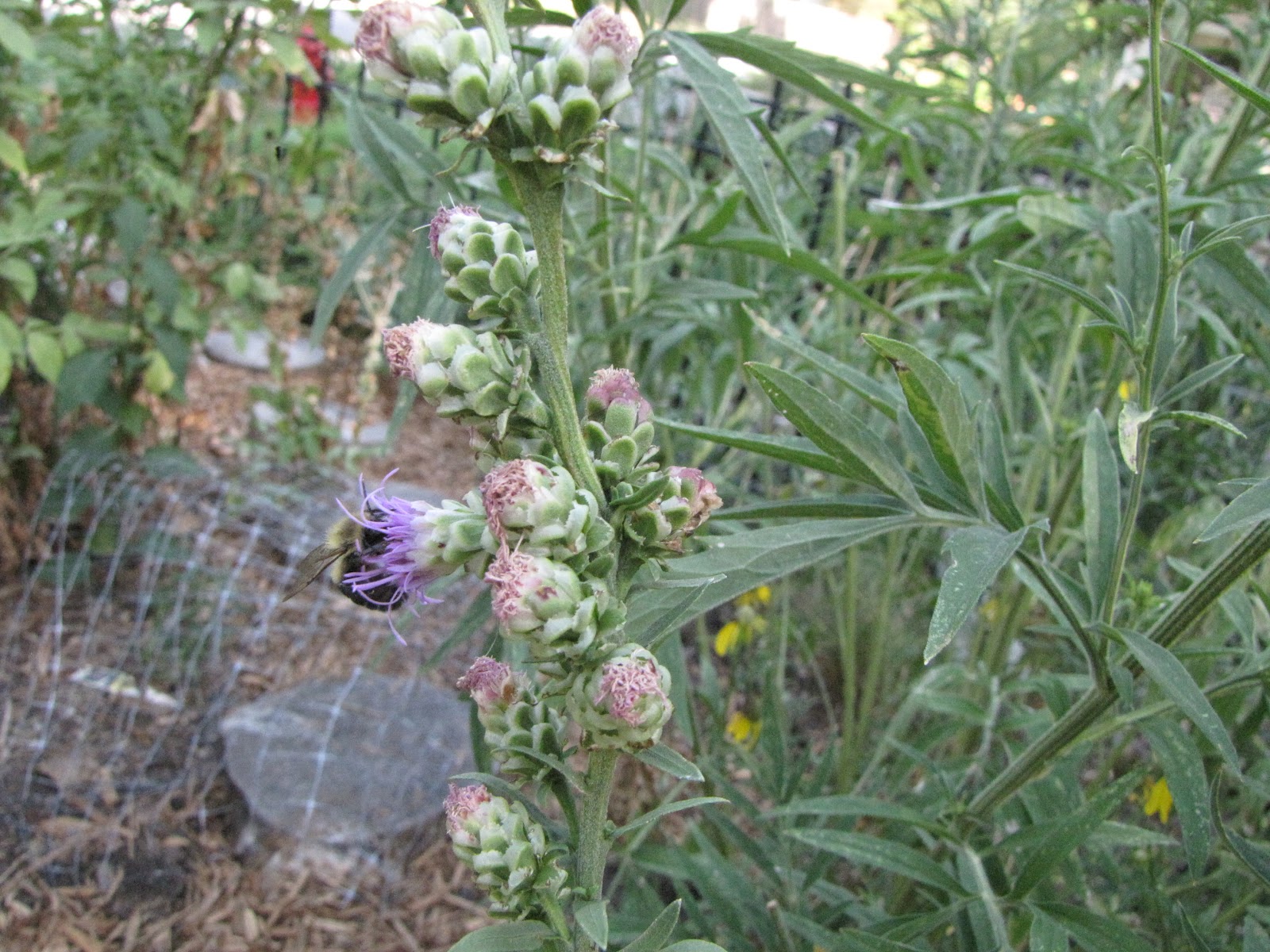
I have 5 of my garden books opened to liatris, and think I have the first one figured out.  This looks like liatris aspera, also called button snakeroot, or rough blazing star.  Oh, and I just learned something.  This used to be called liatris scariosa.  (I have three photos of this one.)


Can you see the bee?  


You can see why "button" is in one of the names for it.


I think these tall, floppy ones are liatris pycnostachya, thick-spike gayfeather.  The blooms are on more of the stalks on these than the ones I saw in my books and online, but I am thinking that is one of the kinds I bought.  They are much thicker than the other liatrises.


The bees like them, too.


Now, there was a tag next to this one, but sometimes a tag will come out from somewhere, and I guess which plant it was.  This one said it's liatris punctata.  I have several of those, and the rabbits have been munching on them.


This one's tag said the same thing, though, and these don't look alike, but I've had a basket over this one so the rabbits couldn't get to it.


This one's tag also said punctata.  I just hope they grow taller and bloom next year.


I wonder if this is another aspera.


They sure like to hold onto their buds awhile!


A few of the liatrises were totally lying on the ground until I propped them up.  I wonder if this is also punctata. 

 Another name for it is dotted gayfeather.
 

This one is a bit taller than the previous one, but I think it may also be punctata.


I like it.

The bees like it, too!


These are the first liatrises that I grew, 'Kobold'.  Someone told me the name of the plant I admired in a church bed, and when I got this, I didn't realize there were so many native ones.  I guess I wasn't looking for native plants so much at the time, either.  These are finished blooming already.


They have self sown around, and while I still like them, I think I am going to cut them down before fall, to avoid more coming up.  I am wondering if I should even grow them if I don't want the native ones to cross with them, though.  I am not ready to pull them out just yet, but it's something I need to think about.


I've had these in the curb area in front of the vegetable garden a number of years.  I'm pretty sure they are punctata.


I scrolled back to the others I thought were the same, but couldn't tell.  These have been here longer, and are in full sun.  They are not getting nearly as much water as the ones in the front.


This is a white blooming one I found somewhere, but as you can see, the rabbits have been eating this one down.


If you recognize what these are, please let me know. 

Thursday, August 2, 2012

Some Kind of Rabbitbrush

Larry and I went to Omaha the other day, and only had time to go to a couple nurseries.  I was pleased to find a nice sized pot of prairie dropseed grass that I fought hard to split into two to plant.  I also got a blooming purple prairie clover, which I promptly put a cage around so the rabbits couldn't feast on it.  There were a couple other other plants I bought that I wasn't as sure about.  My internet wasn't working, so I couldn't look one of them up.  The other, the young man thought was native, but he wasn't sure.

It's interesting how plants can have different names, but it can also be confusing.  Then, there can be different plants that have the same name, which caused me to buy the plant the young man and I thought was native to our area, but I found out is not even native to the U.S.  And, we know that there can be different varieties of plants, as well.

The tag on this plant said the common name is dwarf blue rabbitbrush.  The top part was broken, so not all of the letters of its scientific name were showing.  There were not very many hits when I did a search on it.  I found some information that led me to think this was chrysanthemum nauceosus.  I left a comment on a site about low water needs landscaping, where it was listed, asking if anyone knew the native range.  There was a link to this on Facebook, so two people I know, Gail, and Bertine, who is from Lincoln, gave me information that helped on my quest to figure out what this plant is.


Gail gave me this link, asking me if I thought this was the plant I got.  Here, it was called Ericameria nauseosa, rubber rabbitbrush.  I couldn't tell from the photo, and was confused, because both names were different for it.  Looking at the tag again, I realized that there was the blue bird symbol, which told me it originally came from Bluebird Nursery, which is in Clarkson, Nebraska.  I called them, and explained about the tag, asking if they could tell me whether it is native to Nebraska.  I was impressed that the woman who answered the phone was able to get the information for me.  Guess what, Gail?  You were right!  It is Ericameria nauseosa, and I just noticed the site said it is known by different names in different areas, and can become "weedy or invasive".


Bertine, this site says "nauseosa" refers to the smell given off when the leaves or flowers are crushed.  I didn't think to check that out, though.


Isn't this a cute little plant?  This is the one the nice young man who I enjoyed visiting with about birds and butterflies thought was native.


After going on some garden tours this spring, I was thinking I'd like to find a spot for St. John's Wort.  When I saw this, I knew it wasn't the bush I'd seen, but I was pleased to see the butterfly symbol on it, so I thought I'd take a chance.  I figured I'd find somewhere else for it besides the front yard if it wasn't.


Today, I figured out where to put these two plants.  I have a small area in front of the vegetable garden that does not get as much water as the other beds. It normally looks better than it does now, due to the heat and lack of rain, but I thought I'd show the area a bit since I haven't in awhile.  I have had some holes that needed filling, so I'm glad I thought to put them there.  There are mostly white or yellow blooming flowers, and also plants with foliage with other colors besides plain green, and both of these fit into that category.


I need to deadhead the veronicas.  The bushy blooms in front of it are a perennial statice, or limonium, I'm forgetting the name of.  The boltonia is flopping over.  The rabbits have been eating the white blooming liatris in this bed.


 I put the St. John's Wort on the other end of the bed.  That's another statice.  I originally planted these to dry the flowers, but they look good so long on the plant, I tend to just leave them there.  The rue in this area didn't do as well this year.  I want to plant some more for the swallowtail caterpillars to eat.


It's planted near the metal sunflower, which I recently got at a garage sale.  The very wilted plant is a phlox.  I should probably cut it back.  The reddish leaved plant is a Chocolate Joe Pye Weed.  Oh, and there are three large type sedums, similar to Autumn Joy that I moved from the curb area this spring.  They didn't seem to mind, and are doing quite well.


Have you ever been confused about names of plants?  I guess there is always something to learn when we garden.  I have pretty much run out of local places to find some of the native plants I don't have yet, and want to find a couple kinds of seeds.  Sometimes when I talk about finding plants that are native to Nebraska, Larry points out to me that I am not native.  Well, I guess he's right about that.  Also, if one is really wanting to be pure, I've read they should find plants and seeds that were actually grown from within a small range of where one has their garden.  I'm sure a number of the "native" plants I am growing do not naturally grow in the same areas as each other, either.  I have told myself I just need to enjoy what little yard space we have, and not be too obsessed with what I plant in it.  We have a nice assortment of plants that are beneficial to different kinds of butterflies, bees, wasps, birds and other critters, and there is no way I will ever have a real meadow or prairie.  I'm just glad our neighbors don't complain about it.

I go back to work a week from tomorrow. I worked summer school, and didn't get as much done as I wanted to this summer, but since it's so hot, and I don't feel like being out in this, I am ready to go back to that routine.  There was a chance I was going to work fewer hours, but my boss and I decided to keep my 7 hour day.  I do hope to have this part of the yard cleaned up by then, though.  The veronicas will most likely bloom again.

Have a great weekend!  It sounds like we are to go back to some highs in the 80s for a few days instead of the upper 90s and some 100s.

Monday, July 30, 2012

How I Deadhead Butterfly Bushes

I've mentioned in the past that once in awhile, I remember to look at my Statcounter, and one of the things I check on is what kind of searches people have done that led them to my blog.  Do you ever do that?  One of the most common ones is whether one can eat ornamental sweet potatoes.  Another is whether you can eat the stems and leaves of regular sweet potato plants.  I know you can, but don't know the details.  (Are the ornamental vines edible?)  If you have knowledge or experience cooking and eating them, please leave a comment and let us know.  I'd like to try them myself.  (I think I've seen finished dishes with them on FB or other blogs, but since I didn't try it then, I don't remember what I may have read.)

For some reason, maybe the words in the search, people have been coming to my blog trying to see if they can deadhead or cut back their butterfly bushes.  I took some photos of my second trim of the season so I could show how I do it.  I should mention that I am buying more and more plants that are native, and am avoiding plants that tend to spread farther than they should.  Butterfly bushes are considered invasive in some places, so this post is not an endorsement of growing them, and it may not even be the recommended way to take care of them, but it's how I do it.

I cut this back July 3rd because we have company on the Fourth, and there were a number of bees on the blooms close to where we walk back and forth between the front and back yards, and I wanted to insure the safety of both bees and humans.


There were both spent and new blooms on the bush. 


 I cut at the place next to where the new blooms or buds were.  I cut close to the base, but left a little bit.


This isn't the same one I cut in the previous photo, but if you look at the top two blooms, you can see one of the cuts I made in between them.   I see there is a cut I made on the right side of the photo as well. 


In some cases, I cut further back to make the bush a bit smaller.  Here are some buds that will be blooming soon.


I cut finished flowers off at any time in the season, sometimes a few at a time, and other times, I cut off stems that are sprawling.  I also cut some of the stems on the top left that were sticking up taller than the rest of the plant.  Someone else could probably shape this up better, but I am satisfied for now.


I pushed the stems down 3 times in this 5 gallon bucket.  These ended up on the compost pile.  I have never had this kind reseed. 


Here's a closer view.  No more brown blooms!


As I was about to put my things away, this skipper landed on a bloom.  I was pleased to see it.


If you have another way you deadhead or trim your butterfly bushes, feel free to share.  I normally use pruners instead of garden scissors, but these were handy and clean.  I clean my pruners and garden scissors with rubbing alcohol.

Happy Gardening!

Added a few minutes after publishing:

Well, I need to tell you something embarrassing.  I went back to see what other searches people have been doing when they ended up on my blog, because I forgot to do that before I published this.  I saw there was a link to the post where a person who did this search landed, and it was a September 2009 one, where I pretty much did the same post as this.  It's here, now, so I'll leave it.  I got a number of comments on that one, and most people said they do deadhead theirs. 

Oh, and many of the other searches have to do with folks looking for ideas for gardening in corners, which is because of my blog title.  Some also have looked for ideas for planting around fire hydrants.  LOL  I think it's cool that searches of individual plants have led to some of my photos, and then, the blog.  We need to be careful with that, though, because sometimes I have been a little off, or a different plant was shown in the search than what was supposed to.  I've noticed that with searches I've done, as well.

What searches lead folks to your blogs?